

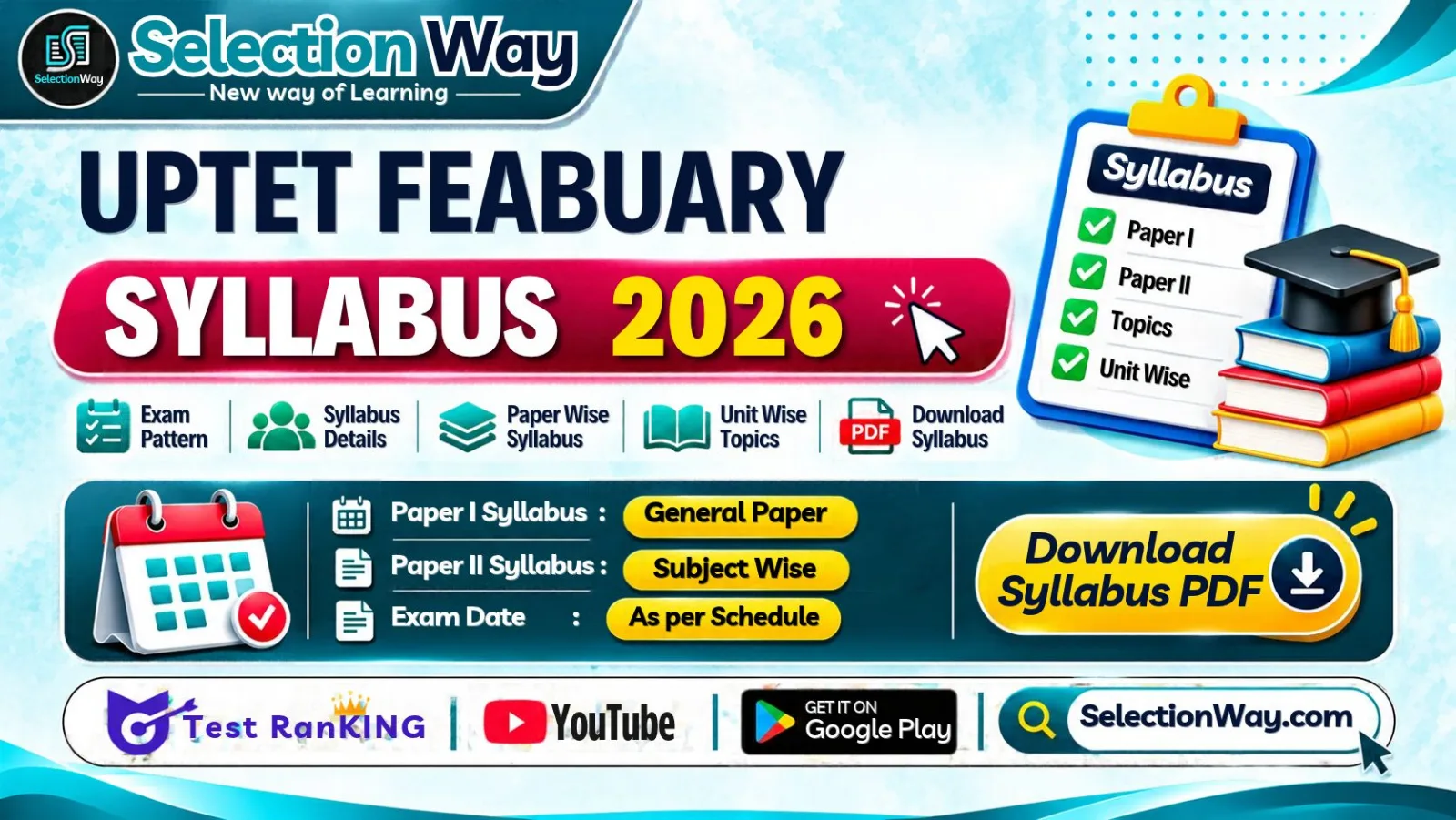
The Uttar Pradesh Education Service Selection Commission (UPESSC) conducts the Uttar Pradesh Teacher Eligibility Test (UPTET) for candidates who want to teach Classes 1 to 5 and Classes 6 to 8 in Uttar Pradesh schools. The examination has two papers: Paper 1 for the Primary Level and Paper 2 for the Upper Primary Level. Candidates can check the subject-wise syllabus, exam pattern, important topics, and preparation details in this article.
Important Dates
Event | Date |
|---|---|
Short Notification Release Date | 18 November 2026 |
Detailed Advertisement Date | 24 November 2026 |
Online Registration / Application Start Date | 24 November 2026 |
Last Date for Online Application Fee Payment | 23 December 2026 |
Application Correction Last Date | 27 December 2026 |
UPTET 2026 Exam Date | 26 and 27 February 2027 |
Note: The dates above are taken from the UPESSC short notification for Advertisement No. 10/2026. The short notice specifically identifies 23 December 2026 as the last date for fee payment.
Application Fee & Payment Mode
The fee amount should be updated only after checking the detailed UPESSC Advertisement No. 10/2026 notification or instruction booklet.
Category | Application Fee |
|---|---|
General / OBC / EWS | ₹ 1000/- |
SC / ST | ₹ 500/- |
PwD | ₹ 300/- |
Payment Mode: Online payment mode, as specified in the detailed notification.
UPTET Exam Pattern 2026
The UPTET examination is conducted through two papers. Candidates can appear for the paper according to the teaching level for which they want eligibility.
Paper 1 Exam Pattern (Classes 1 to 5)
Subject | Questions | Marks |
|---|---|---|
Child Development and Pedagogy | 30 | 30 |
Language 1 – Hindi | 30 | 30 |
Language 2 – English / Urdu / Sanskrit | 30 | 30 |
Mathematics | 30 | 30 |
Environmental Studies (EVS) | 30 | 30 |
Total | 150 | 150 |
Paper 2 Exam Pattern (Classes 6 to 8)
Subject | Questions | Marks |
|---|---|---|
Child Development and Pedagogy | 30 | 30 |
Language 1 – Hindi | 30 | 30 |
Language 2 – English / Urdu / Sanskrit | 30 | 30 |
Mathematics and Science OR Social Studies | 60 | 60 |
Total | 150 | 150 |
Common Exam Details
Particulars | Details |
|---|---|
Examination | UPTET 2026 |
Number of Papers | 2 |
Questions in Each Paper | 150 |
Total Marks in Each Paper | 150 |
Question Type | Multiple Choice Questions (MCQs) |
Duration | 2 Hours 30 Minutes |
Marks for Each Correct Answer | 1 Mark |
Negative Marking | No negative marking, as stated in the Adda247 syllabus reference |
Note: The subject-wise distribution and marking details above follow the Adda247 syllabus reference. Check the current UPESSC instruction booklet for final confirmation.
UPTET Detailed Syllabus 2026
The syllabus is divided into two papers. Paper 1 is for Primary Level teaching (Classes 1 to 5), while Paper 2 is for Upper Primary Level teaching (Classes 6 to 8).
A. UPTET Paper 1 Syllabus (Classes 1 to 5)
1. Child Development and Pedagogy
Topic | Detailed Topics |
|---|---|
Child Development | Meaning, need, scope and stages of child development |
Areas of Development | Physical, mental, emotional, social and language development |
Creative Development | Development of expressive ability, creativity and creative skills |
Factors Affecting Development | Heredity and environment, including family, society, school and mass media |
Meaning of Learning | Meaning of learning and factors affecting learning |
Methods of Learning | Effective methods of learning |
Thorndike's Theory | Laws of learning and their importance |
Learning Theories | Trial and Error Theory, Pavlov's Conditioning Theory, Skinner's Operant Conditioning, Kohler's Insight Theory, Piaget's Theory and Vygotsky's Theory |
Learning Curve | Meaning and types of learning curves |
Learning Difficulties | Causes of learning difficulties and their remedies |
Teaching | Meaning and objectives of teaching |
Teaching Methods | Principles, sources, techniques and innovative teaching methods |
Micro-Teaching | Micro-teaching and basic teaching skills |
Inclusive Education | Meaning, identification, types and remedies related to inclusive education |
Inclusive Groups | Inclusion related to language, religion, caste, region, colour, gender, and physical or mental challenges. |
Teaching Support | Teaching aids, materials, methods, TLM and classroom activities |
Assessment | Tools and techniques for assessing the learning of inclusive children |
Special Teaching Methods | Special methods for children with disabilities, including Braille |
Guidance and Counselling | Meaning, objectives, types, methods, needs and scope |
Support Institutions | Psychological laboratories, divisional psychological centres, district hospitals, DIET institutions, inspection systems, school committees and government or non-government organisations |
Learning and Teaching | How children think and learn |
School Performance | Reasons for success and failure in school performance |
Social Learning | Learning as a social process |
Problem Solving | Child as a problem solver and scientific thinker |
Learning Errors | Alternative concepts in learning and understanding children's errors |
Motivation | Motivation and learning |
Learning Factors | Personal and environmental factors affecting learning |
2. Language 1 – Hindi
Topic | Detailed Topics |
|---|---|
Reading Comprehension | अपठित अनुच्छेद |
Hindi Alphabet | हिंदी वर्णमाला – स्वर और व्यंजन |
Word Formation | वर्णों के मेल से मात्रिक तथा अमात्रिक शब्दों की पहचान |
Sentence Formation | वाक्य रचना |
Hindi Sounds | श, स, ष, ब, व, ड़, ढ़, क्ष, त्र, ज्ञ तथा न की ध्वनियों का अंतर |
Sound Differences | ध्वनियों, वर्णों, अनुस्वार, अनुनासिक और चंद्रबिंदु के बीच अंतर |
Conjunct Letters | संयुक्ताक्षर एवं अनुनासिक ध्वनियों से बने शब्द |
Matras | सभी प्रकार की मात्राएँ |
Punctuation | अल्प विराम, अर्ध विराम, पूर्ण विराम, प्रश्नवाचक और विस्मयबोधक चिह्न |
Vocabulary | विलोम, समानार्थी, तुकांत, अतुकांत तथा समान ध्वनि वाले शब्द |
Grammar | संज्ञा, सर्वनाम, क्रिया और विशेषण के भेद |
Grammar | वचन, लिंग और काल |
Word Structure | प्रत्यय, उपसर्ग, तत्सम, तद्भव और देशज शब्द |
Idioms and Proverbs | लोकोक्तियाँ और मुहावरों के अर्थ |
Sandhi | स्वर संधि, दीर्घ संधि, गुण संधि, वृद्धि संधि, यण संधि, अयादि संधि, व्यंजन संधि और विसर्ग संधि |
Other Grammar | वाच्य, समास और अलंकार के भेद |
Literature | कवियों और लेखकों की रचनाएँ |
Hindi Language Pedagogy
Topic | Detailed Topics |
|---|---|
Language Learning | अधिगम और अर्जन |
Teaching Principles | भाषा अध्यापन के सिद्धांत |
Listening and Speaking | सुनने और बोलने की भूमिका |
Language Use | भाषा के कार्य और बालक द्वारा भाषा का प्रयोग |
Grammar in Language Learning | मौखिक और लिखित अभिव्यक्ति में व्याकरण की भूमिका |
Classroom Challenges | भाषा की कठिनाइयाँ, त्रुटियाँ और विकार |
Language Skills | सुनना, बोलना, पढ़ना और लिखना |
Language Assessment | भाषा बोधगम्यता और प्रवीणता का मूल्यांकन |
Teaching Materials | पाठ्यपुस्तकें, मल्टीमीडिया सामग्री और बहुभाषी संसाधन |
Remedial Teaching | उपचारात्मक अध्यापन |
3. Language 2 – English / Urdu / Sanskrit
The Adda247 reference gives a common topic summary for Language 2. Candidates should check the detailed official booklet for the language-specific syllabus.
Topic | Detailed Topics |
|---|---|
Reading Comprehension | Unseen passage |
Sentence Structure | Subject, predicate and kinds of sentences |
Parts of Speech | Noun, pronoun, verb, adjective, adverb, preposition and conjunction |
Tenses | Present, past and future |
Articles | Use of articles |
Punctuation | Punctuation marks |
Word Formation | Word formation |
Voice | Active and passive voice |
Number | Singular and plural |
Gender | Gender |
4. Mathematics
Topic | Detailed Topics |
|---|---|
Numbers | Numbers and basic number operations |
Basic Operations | Addition, subtraction, multiplication and division |
LCM and HCF | Least Common Multiple and Highest Common Factor |
Fractions | Fractions and decimals |
Basic Rules | Basic mathematical rules |
Percentage | Percentage |
Profit and Loss | Profit and loss |
Simple Interest | Simple interest |
Geometry | Shapes, angles, triangles and circles |
Money | Money-related calculations |
Measurement | Time, weight, capacity, length and temperature |
Mensuration | Perimeter and area |
Calendar | Calendar-related questions |
Data Handling | Data handling |
Volume | Volume and capacity |
Time and Distance | Time and distance |
Data Interpretation | Data presentation and interpretation |
Mathematics Pedagogy
Topic | Detailed Topics |
|---|---|
Mathematical Thinking | Nature of mathematical thinking |
Curriculum | Place of mathematics in the curriculum |
Mathematical Language | Use of mathematical language |
Community Mathematics | Community mathematics |
Assessment | Formal and informal assessment |
Teaching Difficulties | Problems in teaching mathematics |
Error Analysis | Analysis of students' errors |
Remedial Teaching | Diagnostic and remedial teaching |
5. Environmental Studies (EVS)
Topic | Detailed Topics |
|---|---|
Family | Family and family relationships |
Food and Health | Food, health and cleanliness |
Shelter | Shelter |
Plants and Animals | Plants and animals |
Surroundings | Our surroundings |
Festivals | Festivals |
Occupations | Different occupations |
Water | Water |
Transport | Transport and communication |
Games | Games and sports |
India | India, rivers, mountains, forests and transport |
State | Our state |
Constitution | Constitution |
Governance | Local bodies, panchayats, municipal corporations, state and national governance |
National Identity | National symbols, festivals, voting and national unity |
Environment | Environment and its importance |
Conservation | Environmental conservation and social responsibility |
Government Schemes | Government schemes related to the listed areas |
EVS Pedagogy
Topic | Detailed Topics |
|---|---|
EVS Concept | Concept and scope of EVS |
Integrated EVS | Importance of integrated EVS |
Environmental Education | EVS and environmental education |
Learning Theories | Learning theories |
Subject Relationship | Relationship between science and social science |
Concept Presentation | Presentation of concepts |
Practical Work | Activities and practical work |
Discussion | Discussion method |
Evaluation | Continuous and comprehensive evaluation |
Teaching Materials | Teaching materials and tools |
Teaching Problems | Problems in teaching EVS |
B. UPTET Paper 2 Syllabus (Classes 6 to 8)
1. Child Development and Pedagogy
Topic | Detailed Topics |
|---|---|
Child Development | Meaning, need, scope and stages of child development |
Areas of Development | Physical, mental, emotional, social and language development |
Creative Development | Development of expression ability, creativity and creative potential |
Factors Affecting Development | Heredity and environment, including family, society, school and mass media |
Learning | Meaning of learning and factors influencing learning |
Learning Methods | Effective learning methods |
Thorndike's Theory | Laws of learning and their importance |
Learning Theories | Trial and Error Theory, Pavlov's Conditioning Theory, Skinner's Operant Conditioning, Kohler's Insight Theory, Piaget's Cognitive Development Theory and Vygotsky's Socio-cultural Theory |
Learning Curve | Meaning and types of learning curves |
Learning Difficulties | Causes of learning difficulties and their remedies |
Teaching | Meaning and objectives of teaching |
Teaching Communication | Communication and principles of teaching |
Teaching Techniques | Sources and techniques of teaching |
Teaching Methods | Innovative teaching approaches and micro-teaching |
Teaching Skills | Basic teaching skills |
Inclusive Education | Meaning, identification, types and remedies |
Inclusive Groups | Inclusion related to language, religion, caste, region, colour, gender and physical or mental challenges |
Teaching Support | Teaching aids, materials, methods, TLM and activities |
Assessment | Tools and techniques to assess inclusive children's learning |
Special Teaching Methods | Special methods, including Braille |
Guidance and Counselling | Meaning, objectives, types, methods, needs and scope |
Support Institutions | Psychological laboratories, divisional psychological centres, district hospitals, DIET institutions, trained mentors, inspection systems, school committees and government or non-government organisations |
Learning and Teaching | How children think and learn |
School Performance | Reasons for success and failure in school performance |
Social Learning | Learning as a social process |
Problem Solving | Child as a problem solver and scientific investigator |
Learning Errors | Alternative concepts and understanding children's errors |
Motivation | Motivation and learning |
Learning Factors | Personal and environmental factors influencing learning |
2. Language 1 – Hindi
Topic | Detailed Topics |
|---|---|
Reading | Reading comprehension |
Grammar | Hindi grammar |
Teaching Principles | भाषा शिक्षण के सिद्धांत |
Language Skills | भाषा कौशल का विकास |
Assessment | मूल्यांकन प्रक्रिया |
Remedial Teaching | उपचारात्मक शिक्षण |
3. Language 2 – English / Urdu / Sanskrit
The Adda247 reference lists the following common topics for Language 2.
Topic | Detailed Topics |
|---|---|
Reading Comprehension | Unseen passage |
Nouns | Nouns and their kinds |
Pronouns | Pronouns and their kinds |
Verbs | Verbs and their kinds |
Adjectives | Adjectives, kinds and degrees |
Adverbs | Adverbs and their kinds |
Prepositions | Prepositions and their kinds |
Conjunctions | Conjunctions and their kinds |
Interjections | Interjections |
Number | Singular and plural |
Sentence Structure | Subject and predicate |
Sentence Types | Negative and interrogative sentences |
Gender | Masculine and feminine genders |
Punctuation | Punctuation |
Word Formation | Root words and suffixes |
Phrasal Verbs | Phrasal verbs |
Pronoun Usage | Use of somebody, nobody and anybody |
Parts of Speech | Parts of speech |
Narration | Narration |
Voice | Active and passive voice |
Vocabulary | Antonyms and synonyms |
Homophones | Homophones |
Sentence Usage | Use of requests in sentences |
Silent Letters | Silent letters in words |
4. Mathematics (Optional)
Topic | Detailed Topics |
|---|---|
Number System | Natural numbers, whole numbers and rational numbers |
Integers | Integers |
LCM and HCF | Least Common Multiple and Highest Common Factor |
Roots | Square root and cube root |
Algebra | Algebraic expressions and identities |
Equations | Linear, quadratic and simultaneous equations |
Geometry | Parallel lines, quadrilaterals, triangles, circles and tangents |
Ratio and Proportion | Ratio and proportion |
Percentage | Percentage |
Commercial Mathematics | Profit and loss, simple interest, compound interest, tax and banking |
Statistics | Classification of data, mean, median and mode |
Charts | Bar charts and pie charts |
Probability | Probability |
Mensuration | Mensuration |
Exponents | Exponents |
Mathematics Pedagogy
Topic | Detailed Topics |
|---|---|
Logical Thinking | Nature of mathematical and logical thinking |
Curriculum | Place of mathematics in the curriculum |
Mathematical Language | Mathematical language |
Community Mathematics | Community mathematics |
Assessment | Assessment |
Remedial Teaching | Remedial teaching |
Teaching Difficulties | Teaching difficulties |
5. Science (Optional)
Topic | Detailed Topics |
|---|---|
Science in Daily Life | Science in daily life and technological development |
Living and Non-living | Living and non-living things |
Classification | Classification of plants and animals |
Human Body | Human body systems |
Nutrition | Nutrition in plants and animals |
Health | Health, hygiene and diseases |
Matter | Matter |
Force and Motion | Force and motion |
Energy | Energy |
Sound and Light | Sound and light |
Electricity and Magnetism | Electricity and magnetism |
Environment | Environment, air, water and soil |
Pollution | Pollution and conservation |
Natural Resources | Natural resources |
Alternative Energy | Alternative energy sources |
Carbon | Carbon and its compounds |
Science Pedagogy
Topic | Detailed Topics |
|---|---|
Nature of Science | Nature and structure of science |
Science Education | Aims and objectives of science education |
Scientific Method | Scientific inquiry and experimentation |
Creativity | Innovation and creativity |
Teaching Materials | Teaching-learning materials |
Assessment | Assessment |
Remedial Teaching | Remedial teaching |
6. Social Studies (Optional)
Subject Area | Detailed Topics |
|---|---|
History | Sources of history; ancient, medieval and modern Indian history; freedom movement; post-independence challenges |
Civics | Society, governance, constitution, democracy, citizenship, national security and foreign policy |
Geography | Earth, globe, maps, climate, resources, population and disasters |
Indian Geography | Geography of India and Uttar Pradesh |
Environmental Studies | Environment, natural resources, pollution, conservation and disaster management |
Home Science | Health, nutrition, hygiene, food preservation and household management |
Physical Education | Physical education, yoga, games, national and international sports and first aid |
Music | Swar knowledge, ragas, rhythm, patriotic songs and devotional songs |
Agriculture | Soil, irrigation and crops |
Horticulture | Fruits, vegetables, preservation and climate science |
Social Studies Pedagogy
Topic | Detailed Topics |
|---|---|
Teaching Concepts | Concepts and methods of social studies teaching |
Classroom Process | Classroom processes and activities |
Discussion | Discussion method |
Project Work | Project work |
Assessment | Assessment |
Important: The Paper 2 optional subject topics above reproduce the subject groupings and topic summaries shown in the Adda247 reference. Check the detailed UPESSC instruction booklet for the final subject selection rules and current-cycle syllabus.
Important Links
Link Description | Link |
|---|---|
UPESSC Official Website | Click Here |
UPTET Application / OTR Portal | Click Here |
UPTET Paper 1 Syllabus PDF | Click Here |
UPTET Paper 2 Syllabus PDF | Click Here |
How To Download UPTET Syllabus
Visit the official UPESSC website: https://upessc.up.gov.in/
Open the UPTET 2026 Advertisement No. 10/2026 section.
Find the detailed notification or instruction booklet.
Open the syllabus and examination pattern section.
Select the required paper: Paper 1 or Paper 2.
Download the official syllabus PDF.
Save the PDF and check the subject-wise topics before starting preparation.
Frequently Asked Questions (FAQs)
Q1. What is the UPTET 2026 syllabus?
The UPTET syllabus includes Child Development and Pedagogy, Language 1, Language 2, Mathematics, Environmental Studies, Science, and Social Studies. The subjects depend on the paper selected by the candidate.
Q2. How many papers are there in UPTET 2026?
There are two papers. Paper 1 is for Classes 1 to 5, and Paper 2 is for Classes 6 to 8.
Q3. What is the UPTET Paper 1 syllabus?
Paper 1 includes Child Development and Pedagogy, Hindi, English/Urdu/Sanskrit, Mathematics, and Environmental Studies.
Q4. What is the UPTET Paper 2 syllabus?
Paper 2 includes Child Development and Pedagogy, Hindi, English/Urdu/Sanskrit, and a 60-mark subject section. Candidates select Mathematics and Science or Social Studies according to the applicable subject rules.
Q5. How many questions are asked in each UPTET paper?
The syllabus reference lists 150 multiple-choice questions in each paper.
Q6. What is the total number of marks in UPTET?
Each paper carries 150 marks according to the referenced examination pattern.
Q7. What is the duration of the UPTET examination?
The referenced pattern gives 2 hours and 30 minutes for each paper.